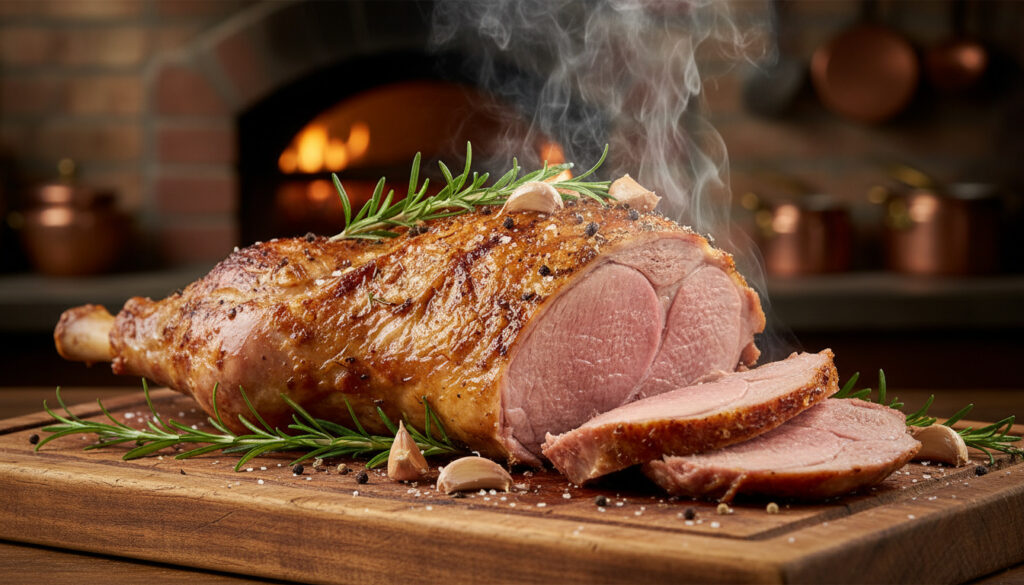
Leg of Lamb Recipe – Precise Oven Roast Guide
Roasted leg of lamb represents the pinnacle of celebratory dining, offering two distinct paths to perfection: a succulent medium-rare roast with a blushing pink center, or fork-tender meat that falls from the bone after hours of slow cooking. Both bone-in and boneless cuts respond to similar fundamental techniques, though the presence of bone fundamentally alters heat conduction and moisture retention. Understanding the relationship between internal temperature, cooking duration, and meat structure separates acceptable results from exceptional ones.
Mastering this dish requires precision in temperature control and patience in preparation. Whether preparing a holiday centerpiece or an intimate dinner, the methods remain grounded in measurable science rather than approximation.
How to Cook a Leg of Lamb
20 minutes (active)
1.5–2 hours
8–10 adults
Medium
- Marinate overnight (12–48 hours) with garlic, rosemary, thyme, and white wine for deep flavor penetration
- Score all surfaces of the lamb, not merely the top, to allow seasoning absorption and proper fat rendering
- Use an oven-safe digital thermometer inserted into the thickest center portion for accuracy
- Remove from heat 5–10 degrees below target temperature to account for carryover cooking
- Rest 10–15 minutes tented under foil before carving to redistribute juices
- Carve against the grain to ensure tender slices
- Bone-in legs (7–9 lbs) require longer cooking than boneless (2–4 lbs) due to heat conduction differences
| Key Fact | Bone-In Leg | Boneless Leg |
|---|---|---|
| Typical Weight | 7–9 pounds (2 lbs bone) | 2–4 pounds |
| Oven Temperature | 325°F standard | 325°F standard |
| Initial Sear | 425°F for 25 minutes | 425°F for 25 minutes |
| Time per Pound (Medium-Rare) | 20–25 minutes | 20 minutes |
| Target Internal (Remove) | 130°F to 135°F | 130°F to 135°F |
| Final Temp After Rest | 135°F to 140°F | 135°F to 140°F |
| Safe USDA Minimum | 145°F | 145°F |
| Resting Duration | 10–15 minutes | 10–15 minutes |
| Primary Aromatics | Garlic, rosemary, thyme | Garlic, rosemary, thyme |
Leg of Lamb Cooking Time and Temperature
Standard Roasting for Medium-Rare to Medium
For a medium-rare result with a pink center, cook the lamb to an internal temperature of 130°F to 135°F. The meat will continue cooking during resting, reaching 135°F to 140°F. Cooking time varies by doneness level at 325°F: rare requires 15 minutes per pound until reaching 125°F internally; medium-rare demands 20 minutes per pound for 130°F to 135°F; medium needs 25 minutes per pound for 135°F to 140°F; well-done requires 30 minutes per pound to reach 155°F to 165°F.
Bone-in legs of 5–7 pounds cooked at 325°F require 20–25 minutes per pound for medium-rare, or 25–30 minutes per pound for medium. The Mediterranean Dish provides detailed timing charts for these variations.
Slow-Cooked Method for Fall-Off-the-Bone Results
For meat that separates effortlessly from the bone, cook covered in foil at 325°F for 4 to 4.5 hours until reaching 202°F to 205°F internally. Then uncover and increase heat to 375°F for the final 30 minutes to brown the exterior. At 325°F, expect approximately 40 minutes per pound to reach 175°F during this slow process, as documented by Billy Parisi.
Place an oven-safe digital thermometer probe exactly into the center of the thickest part of the meat rather than near the bone or surface. Sip and Feast emphasizes that surface readings differ significantly from true internal temperature, leading to inaccurate doneness.
How to Prepare and Season Leg of Lamb
Marination and Flavor Development
Marinate overnight for optimal flavor by wrapping the lamb tightly in plastic wrap and refrigerating for at least 12 hours, or up to 48 hours for deeper flavor. A traditional marinade includes garlic, fresh rosemary, thyme, and white wine. This extended contact allows the acidic wine and aromatic oils to begin tenderizing surface fibers while seasoning the interior, according to Billy Parisi.
Scoring and Surface Preparation
Before roasting, score all sides of the lamb, not just the top. This creates additional surface area for the marinade and subsequent seasoning to penetrate, while also allowing fat to render more effectively during the high-heat initial phase.
Equipment Configuration
Position a wire rack inside the roasting pan to elevate the meat. This allows hot air to circulate evenly beneath the leg, preventing the bottom from steaming in its own juices and promoting uniform browning. An oven-safe digital thermometer provides accuracy unavailable through time estimates alone, as oven calibration variations can alter cooking speeds significantly.
Resting, Carving, and Serving Leg of Lamb
The Resting Phase
Rest the lamb for 10–15 minutes after removing it from the oven, tenting loosely with foil. Sip and Feast and Billy Parisi both stress that during this resting period, the internal temperature will climb 5–10°F, so remove the meat a few degrees below your target temperature.
Remove bone-in legs at 130°F to achieve a final 135–140°F medium-rare result after the mandatory 10–15 minute rest. Skipping this step results in dry meat as juices escape during premature slicing.
Carving Technique
American Lamb recommends carving against the grain for the best texture. Identify the muscle fiber direction before cutting; slicing perpendicular to these lines shortens the fibers and creates tender bites.
Cutting parallel to the grain leaves long, stringy muscle fibers that require excessive chewing. Always carve against the grain regardless of the cooking technique employed.
Bone-In vs Boneless Leg of Lamb Recipes
Both boneless and bone-in cuts use similar cooking methods, though bone-in lamb takes longer and retains more flavor because the bone conducts heat slowly and keeps the meat juicier. The bone acts as a heat sink, moderating temperature fluctuations and providing a reservoir of conducted thermal energy that cooks the meat from within as well as without.
Bone-in legs typically weigh 7–9 pounds total, with about 2 pounds being bone weight; plan accordingly when calculating cooking time per pound. Boneless legs of 2–4 pounds cook faster than bone-in due to reduced mass and no bone conducting heat slowly, as detailed by Billy Parisi.
Step-by-Step Cooking Timeline
-
Marination (12–48 hours prior)
Wrap seasoned lamb tightly in plastic and refrigerate to develop flavor, following the overnight protocol established by traditional recipes.
-
Preparation (30 minutes before cooking)
Remove from refrigeration, score surfaces if not already done, insert thermometer probe, and preheat oven to 425°F.
-
Initial Sear (25 minutes)
Roast at 425°F to brown exterior and take the chill off the meat surface.
-
Primary Roasting (80–90 minutes)
Reduce heat to 350°F and continue until internal temperature reaches 135°F for medium, monitoring with an oven-safe probe.
-
Resting (10–15 minutes)
Tent with foil and allow carryover cooking to complete the temperature rise.
-
Carving (10 minutes)
Slice against the grain and serve immediately.
What Temperature Science Confirms vs What Varies
Established Standards
- USDA recommends 145°F minimum internal temperature for safety
- Chef-preferred medium-rare removes heat at 130–135°F according to ThermoWorks
- Bone-in cuts require 20–25 minutes per pound at 325°F for medium-rare per American Lamb
- Carryover cooking raises temperature 5–10°F during rest
Situational Variables
- Exact minutes per pound vary by oven calibration and altitude
- Initial high-heat searing at 425°F versus constant 350°F depends on browning preference and recipe variation
- Final internal temperature preferences vary by regional tradition and individual taste
Culinary Heritage and Holiday Significance
Bone-in leg of lamb provides an exceptional dinner presentation, making it ideal for holiday meals like Easter. The dramatic tableside appearance of the roasted bone references ancient traditions of communal feasting. While seafood boils offer alternative celebration options centered on communal dining, lamb maintains distinct seasonal associations.
Mediterranean culinary traditions particularly favor the combination of garlic, rosemary, and thyme, herbs that grow wild throughout the region and have historically been used to complement the meat’s delicate flavor. The dish bridges ancient pastoral traditions with modern precision cooking techniques.
Expert Methodology and Source Attribution
“Marinate overnight for optimal flavor by wrapping the lamb tightly in plastic wrap and refrigerating for at least 12 hours, or up to 48 hours for deeper flavor.”
— Billy Parisi, Roast Bone-In Leg of Lamb
“Use an oven-safe digital thermometer for accuracy—place an oven-safe digital thermometer probe exactly into the center of the thickest part of the meat.”
— Sip and Feast, Roasted Boneless Leg of Lamb
Key Takeaways for Perfect Lamb
Perfect leg of lamb requires overnight preparation with garlic and herbs, precise temperature monitoring to 130–135°F for medium-rare, and mandatory resting before carving against the grain. Whether choosing bone-in for presentation and moisture or boneless for reduced cooking time, the fundamentals remain: controlled heat, accurate thermometry, and patience during the rest. For complementary meal planning, consider browsing quick dessert recipes to complete your celebration menu.
Frequently Asked Questions
Can I cook leg of lamb from frozen?
Thaw completely in the refrigerator before cooking. Frozen lamb will not cook evenly and the exterior will overcook while the interior remains unsafe.
What if I don’t have a meat thermometer?
While time-per-pound estimates provide guidance, oven variations make thermometer use strongly recommended for both safety and achieving desired doneness without guesswork.
Can I substitute dried herbs for fresh rosemary and thyme?
Yes, use one-third the quantity of dried herbs as they concentrate flavor during the long cooking process without degrading.
How should I store leftover roasted lamb?
Refrigerate within two hours of cooking, store up to three days covered, or freeze for up to three months in airtight packaging.
Why did my lamb turn out tough?
Overcooking beyond medium doneness or carving with the grain typically causes toughness. Use a thermometer to prevent exceeding target temperatures and carve perpendicular to muscle fibers.
More related posts
 Head & Shoulders Shampoo: Benefits, Ingredients & Reviews
 Miraculous Ladybug Season 6: Release Date, Episodes & Streaming
 Cast of House of Guinness: Full Cast and Roles
 www.digitalnewsalerts.com: News on Games, Gadgets & Tech
 Olympic Opening Ceremony 2026 Time: CET, EST & How to Watch
 Cast of Fool Me Once: Full Cast, Roles & Irish Stars
 4 Feet in Inches – Exact Formula, Chart & Guide
 Курс канадского доллара к гривне – Current Rate & Trends